












Navigating the Deadlock: Accelleron’s Daniel Bischofberger on Green Fuels
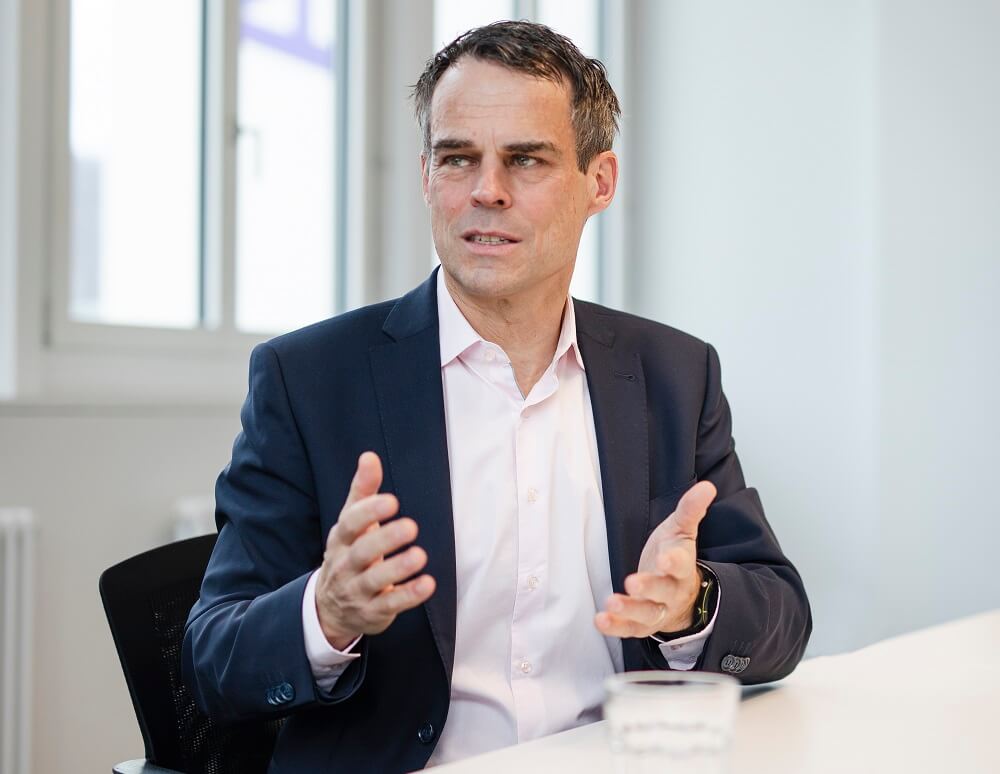 Accelleron, a leading provider of turbocharging, fuel injection, and digital solutions for marine engines and ships, recently released a study on the multifaceted, multi-industry challenges slowing shipping's transition to carbon-neutral fuels. TME recently spoke with CEO Daniel Bischofberger about the current state of marine decarbonization, regional developments in Asia-Pacific, and the path forward for the industry.
Can you describe the current state of shipping's transition to carbon-neutral fuels?
The ships are ready, but the fuel is not. The technology exists – we have ships that can run on methanol, ammonia, and other alternative fuels. The engines are ready, the systems are in place, and there's movement towards hydrogen-based fuels. But these ships aren't able to run on the fuels they were designed for, because the fuels are not yet there.
We're seeing a concerning trend in dual-fuel ships. The dual-fuel portion of the orderbook is decreasing, while the share of conventional petroleum-fueled ships has increased. Within dual-fuel vessels, LNG is now dominant. This shows we're at a deadlock.
What are the key barriers?
Our report identified five interlinked, systemic deadlocks, based on more than 50 interviews with shipowners, ports, bunkering, gas fields, e-fuel developers, and maritime suppliers.
First, there are too many fuels. Between conventional options, LNG, biofuels, methanol, ammonia, and others, investment is diluted. The industry has essentially chosen two long-term pathways – methanol and ammonia – but to scale, it would probably be preferable just to have one clear choice of fuel we want to go after.
Second, production facilities for e-fuels need to be large-scale to be cost-effective. This creates centralized fuel hubs, but we have numerous ports worldwide that need these fuels. Distribution infrastructure becomes a massive challenge.
Third, while there's approximately $3.5 trillion in ESG financing available globally, shipping has only attracted about $14.5 billion. That's a drop in the ocean.
Fourth, regulation doesn't match ambition. The regulatory framework hasn't caught up to the industry's decarbonization goals.
Finally, port infrastructure needs to manage multiple fuel types for bunkering and storage. The investment required is enormous.
How significant is the investment challenge?
For marine alone, fully decarbonizing with hydrogen-based fuels would require 100-150 million tonnes of hydrogen per year – an investment of $2-3 trillion. But shipping isn't alone. Hard-to-decarbonize sectors like aviation, agriculture, cement, steel, chemicals, and power generation need 500-600 million tonnes of hydrogen total, representing about $9 trillion in investment.
The key insight is that no one sector can do this alone. All these industries need production facilities and distribution networks. This is why cross-sector collaboration is essential. We all need production sites and ships to transport fuel to ports, airports, and other facilities. The great thing is that shipping could play the role model, because it’s the only industry that has a global regulator.
What can the industry do during this transition period?
In the meantime, we have a 10-15 year transition period where we can significantly reduce CO2 emissions without waiting for full-scale e-fuels.
Biofuels can help at the beginning, though they're not scalable to the volumes we ultimately need. LNG offers about 30 percent CO2 reduction, though it's not zero emissions. Energy-saving technologies can achieve 35 percent reductions if widely implemented – air lubrication, wind assist devices, improved hull design, propeller optimization, heat recovery systems.
Operational measures matter too: speed optimization, weather routing, and proper maintenance. We offer digital solutions for weather routing where operators can choose between speed and fuel savings. We're also seeing more frequent hull maintenance rather than waiting five years between cleanings.
New ships are more efficient than older vessels, though we can't simply wait for fleet renewal. We need net-zero solutions, and we can't delay.
Are there some regions that are moving faster?
Asia-Pacific is where we're seeing real movement and solutions to the deadlock. Countries like Australia, Japan, Korea, Singapore, and China are moving ahead, driven primarily by government support and funding.
China's motivation is that they want energy security and reduced dependence on fossil fuels. They have abundant renewable energy capacity and can build electrolysis facilities. But it's also an industrial strategy. Just as they dominated wind turbines, photovoltaics, batteries, and rare earths, they want to be a major player in e-fuels because they believe the world needs them for climate goals.
On the production side, Australia and China are moving ahead with ammonia production. We're seeing smaller, modular production facilities being developed – not the massive facilities requiring millions of tons of hydrogen, but smaller 300,000-ton units. There are lots of subsidies, so the prices are not really correlating with the cost.
On the demand side, ports in Singapore, China, and Korea are advancing. They're developing this infrastructure first for uses outside marine. Japan, for example, wants to blend ammonia into the boilers of coal-fired power plants to reduce CO2 emissions. They're combining uses in power generation, agriculture, and marine – exactly the cross-sector approach we've been advocating.
They also have strong trade corridors. The iron ore route from Australia to Singapore and China is ideal – you have production hubs at both ends of the corridor.
What lessons can the global industry learn from Asia-Pacific?
The key lesson is that we don't have to wait for perfect global regulation before moving forward. The Asia-Pacific demonstrates this. However, they can only go so far without a global framework.
We need an IMO net-zero framework that makes fossil fuels more expensive through CO2 taxes while helping alternative fuels become cheaper through scaling and temporary subsidies. Some movement is happening, and we can learn tremendously from the Asia-Pacific region.
How does Accelleron fit into this transition?
We offer turbochargers, fuel injection systems, and digital solutions. Our technology is fuel-agnostic – it works with fossil fuels and alternative fuels alike. Our focus is on efficiency: vessel performance optimization and enabling new fuels.
Efficiency is crucial both today and tomorrow. In a fossil fuel world, it reduces CO2 emissions. In an e-fuel world, it's even more important because e-fuels have poor round-trip efficiency – you put in 100 units of energy and get about 20 units out. Given the massive investment required for hydrogen infrastructure, the best approach is to minimize fuel consumption. Efficiency matters today, tomorrow, and beyond.
What became clear when we started this report – and I come from the power generation and oil and gas sectors – is that nobody is connecting the dots. Aviation only thinks about aviation, power generation only about power. We're trying to change that mindset. Don't fight your own battle alone – join forces and get this done together.
We provide a small but important piece of the decarbonization journey, and through this report, we're using our network to spread information and help people find solutions.
What does the future look like for internal combustion engines in a decarbonized world? Do they have a long-term role?
When Accelleron went public about four years ago as a spin-off from ABB, potential investors questioned why we were listing when we supposedly had only a 10-year shelf life. The European idea at the time was no passenger cars with combustion engines by 2035.
We explained that shipping is hard to decarbonize. You can't fully decarbonize just by going battery-electric. Don't misunderstand – whatever we can electrify, we should, because battery efficiency is far superior to e-fuels. But for shipping, battery-electric has severe limitations.
Consider a large container ship traveling from China to Europe – it requires 40 gigawatt-hours of energy. Switzerland's largest nuclear power plant would need to run for a day and a half just to provide that electricity. With current battery technology, most of the ship's freight capacity would be used up by the weight of the batteries needed to store the energy. The ship would exist only to move and recharge batteries. Plus recharging would take days.
Unless battery weight decreases dramatically – which isn't on the horizon – batteries won't work for long-distance shipping.
Nuclear power is interesting, but it's land-based currently. Moving to ships requires societal acceptance, which takes time. Look at Switzerland – before Fukushima, we were planning new nuclear plants. Now we're reconsidering. Nuclear propulsion needs regulation, crew confidence, and broad acceptance.
We've looked at fuel cells, including turbocharged fuel cells, and we see technical challenges there too. Based on all this, I believe combustion engines will remain relevant well beyond 2050. Aviation and marine each need about 300 million tonnes of fuel annually. But shipping moves 90% of all goods with its 300 million tonnes of fuel, while aviation moves many people but relatively few goods. Shipping is extremely efficient, and combustion engines are highly efficient. They can run on net-zero fuels.
E-fuel costs will come down through scaling and temporary subsidies – probably to two or three times current bunker fuel prices. I think energy should cost something, or it gets wasted.
Will combustion engines with e-fuels be the only solution? No, most likely not. But I believe they'll be the main solution because I don't see viable substitutes at scale.
There will definitely be niche applications for other technologies. Ferries already run on batteries because they're short-distance, lightweight, and have sufficient charging time. There's no silver bullet, but one of the bigger solutions is definitely combustion engines with e-fuels, alongside other technologies.
Given all these challenges, are you optimistic about the industry's path forward?
I am. While global regulation may lag, some regions are moving ahead, and that creates competitive advantages. Countries that move first will benefit.

that matters most
Get the latest maritime news delivered to your inbox daily.
I believe climate change is real, and we should develop and invest in technologies that help now. We shouldn't wait. The good news is that even in this deadlock, we have solutions available today that can significantly reduce emissions while we work toward the longer-term transition.
The key is not waiting for perfection. Use what's available – wind assist, efficiency technologies, operational improvements, transition fuels. And critically, work across sectors. The hydrogen economy serves multiple industries, and collaboration will get us there faster and more cost-effectively than any sector going it alone. - TME
Content Original Link:
" target="_blank">