










China Merchants Is the Latest to Withdraw from China’s Cruise Market
China Merchants, one of the country’s largest industrial companies and heavily involved in the maritime sector, has abandoned its efforts to develop a luxury Chinese cruise product. The company had launched a joint venture with Viking in 2021, acquiring one of Viking’s cruise ships, but recently put the cruise ship up for sale.
The company had reportedly paid nearly $400 million in 2021 as part of the joint venture to take control of the 745-foot Viking Sun (47,800 gross tons). Built by Fincantieri and introduced in 2017 as the fourth of Viking’s ocean cruise ships, the ship was rechristened Zhao ShangYi Dun (China Merchants Eden). It was listed in February with the Beijing Equity Exchange, with a minimum price of RMB 2.9 billion (which, depending on exchange rates, could be as much as $420 million).
Bids were due by mid-March, with some speculation that Viking might reacquire the vessel, although it has been quietly removed from Viking’s webpage. China Merchants set strict terms requiring the buyer to remove all China Merchants branding from the ship within one month of completing the purchase, and they were prohibited from marketing the ship with any association or note of its past association with China Merchants. Further, it stated the Viking branding, the names of all the public spaces, including the restaurants aboard, and operating systems are licensed from Viking, but the license is not part of the sale. The buyer can negotiate a new agreement with Viking or relinquish the use of the licensed branding and systems.
The operation had been positioned as a high-end luxury cruise tailored to the Chinese market. However, when it launched in 2021, China was still closed due to the COVID-19 pandemic, and the ship was limited to coastal cruises. It sailed at different times from the ports of Shanghai, Shenzhen, and Tianjin. Pricing was reported to be at the high-end of the Chinese market, and extra tariff options aboard the ship further increased the total cost.
When China finally reopened cruising to the international market, the joint venture attempted to reposition Yi Dun from 5 to 8-day coastal cruises. They introduced a 15-day cruise to Japan and South Korea. Between September and November in 2024 and again in 2025, Viking marketed the ship to the international market for cruises from China. However, reports are that the ship often sailed with 600 passengers, significantly below its 930-passenger capacity, and continued to report financial losses.
For 2026, Viking had planned to reposition the Yi Dun to Europe. Viking had built a successful fly-cruise business from China with its river cruises in the past, devoting some ships to Chinese passengers.
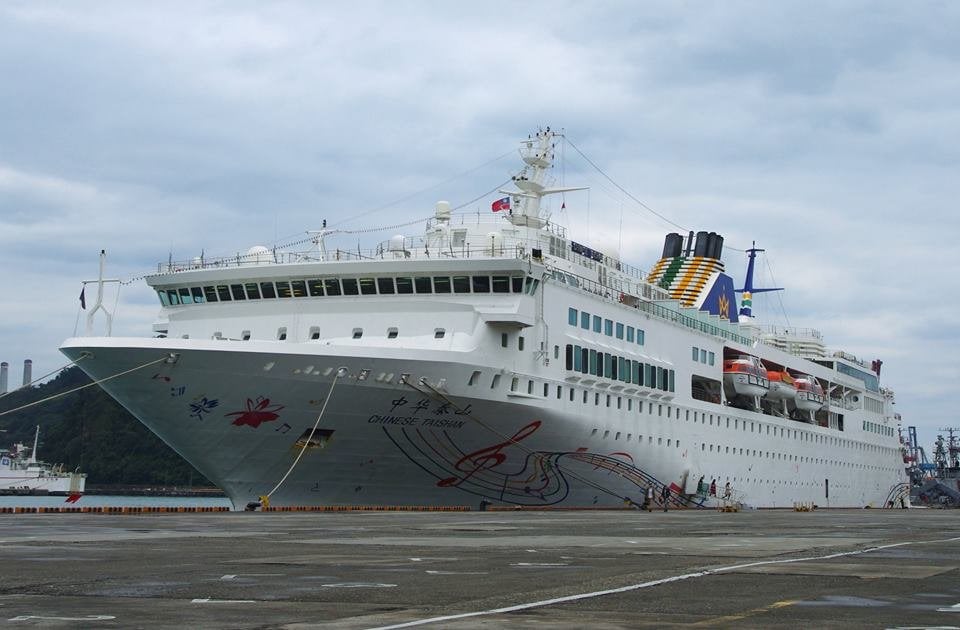
Chinese Taishan - Taiwan International Ports
China Merchants’ decision to exit the cruise market follows smaller companies, including ferry operator Bohai, which earlier this month reported its board of directors was putting its single cruise ship up for sale for $23 million. Bohai paid nearly $44 million in 2014 to acquire a cruise ship, Voyager (24,500 gross tons), from Carnival Corporation’s Costa. The ship entered service in 2000 and was acquired by Costa five years later when the original cruise line owners went bankrupt. She had sailed in China as the Chinese Taishan but, according to reports, never resumed service after the pandemic.

that matters most
Get the latest maritime news delivered to your inbox daily.
China’s Blue Dream Cruises, another small independent firm, went bankrupt earlier this year. It cited geopolitical tensions that had forced it to shift its itineraries away from Japan and South Korea. The company had two cruise ships, with reports that one was placed under arrest for debts, and both have been listed for sale. In addition, a former British cruise ship, which had been acquired by a regional tourism operation and launched as Piano Land, is heading to Spain in July for a new company. The operation was merged into a new Chinese cruise holding company, but the ship built in 1995 has aged out of the Chinese market due to a Ministry of Transport regulation that bars ships more than 30 years of age from operating from mainland China.
Reports highlight that the Chinese consumer is mostly interested in family cruising and shorter trips focused on the destinations. MSC Cruises and Royal Caribbean International have been successful in re-entering the market with mega cruise ships with extensive amusements, which have a stronger appeal to the Chinese traveler. However, with a less developed marketing base, China remains a more challenging segment for the industry. Most of the Western cruise lines did not reposition ships to homeport in China after the pandemic. The Chinese cruise market, however, continued to show strong growth, with passenger levels up nearly 28 percent for the first 11 months of 2025, and China's Adora Cruises recently saw its second domestically built cruise ship floated ahead of a year-end delivery while the company placed an order for two ships and an option for a third, all to be built in China.
Content Original Link:
" target="_blank">