








Mitsui O.S.K. Lines (MOL), Kanadevia Corporation, and Yanmar Power Solutions have achieved a 98% methane slip reduction rate in onboard trials of LNG-fueled vessels, exceeding their initial target of 70%.The trials are
Mitsui O.S.K. Lines (MOL), Kanadevia Corporation, and Yanmar Power Solutions have achieved a 98% methane slip reduction rate in onboard trials of LNG-fueled vessels, exceeding their initial target of 70%.
The trials are part of the Green Innovation Fund Project ‘Development of Next-Generation Vessels’ led by Japan’s New Energy and Industrial Technology Development Organization (NEDO).
The project, which runs from fiscal 2021 through 2026, aims to combine methane oxidation catalysts with engine improvements to reduce methane slip - unburned methane emissions from LNG fuel - by at least 70%.
The three companies began full-scale demonstration trials in May 2025 on routes including between Japan and Australia, using the LNG-fueled large coal carrier REIMEI, operated by MOL.
Despite fluctuating engine room conditions and varying load rates encountered under actual operating conditions, the system achieved a 98% reduction rate at the practical operating range under 75% load, surpassing results from earlier land-based tests, according to the companies.
Earlier land-based trials had already achieved a 93.8% reduction rate at 100% load and received certification from Nippon Kaiji Kyokai (ClassNK), putting the project ahead of similar efforts worldwide.
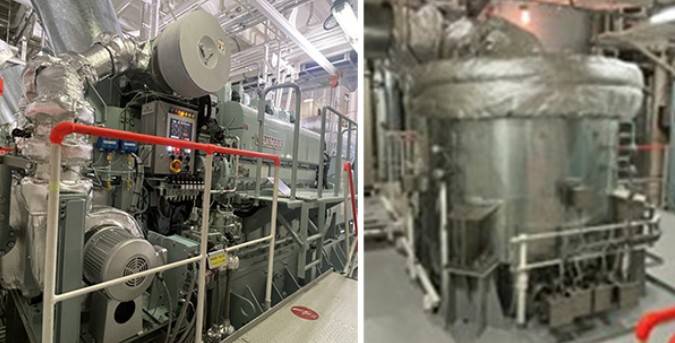 Methane slip reduction system on board - Left: EGR system; Right: Methane oxidation catalyst layer (Credit:
Content Original Link:
" target="_blank">