













Port Wars in the Horn of Africa
Egyptian government sources have briefed the UAE’s National newspaper that Egypt is to help develop the ports of Assab in Eritrea and Doraleh in Djibouti, in part to better host the Egyptian naval vessels which already visit these ports, and apparently as part of its long-running campaign to put pressure on Ethiopia.
Egypt has for some time being trying to force Ethiopia to negotiate over Nile water flows governed by the Grand Ethiopian Renaissance Dam (GERD). The dam was finally declared complete and filled to design height in September. Egypt has been concerned that Ethiopia will restrict Nile water flows, on which it depends heavily both for agriculture and for drinking water. Ethiopia has refused to compromise its sovereignty by making international treaties governing the water flow, but has promised to behave responsibly.
In practice, Ethiopia has been controlling water flows for the last five years, since the early phases of construction and filling of the GERD were completed. Contrary to Egyptian fears, Ethiopia has maintained water flows at previous levels, and indeed during heavy rains in 2022 and above average rains in 2024, has protected downstream areas in Sudan and into southern Egypt from the worst of potentially catastrophic flooding.
The reserve of water now held behind the dam is sufficient to maintain flows at times of drought, another benefit. Hydroelectric power greatly in surplus of Ethiopia’s requirements is being generated, and cheap electricity will be transformational in Sudan, once stability returns to the country. This supply will double Ethiopia’s generating capacity, and hit 13,000 megawatts by 2028. This is powering the country’s first internationally-developed gold mine, being developed by Kefi and going into production at Tulu Kapi this month.
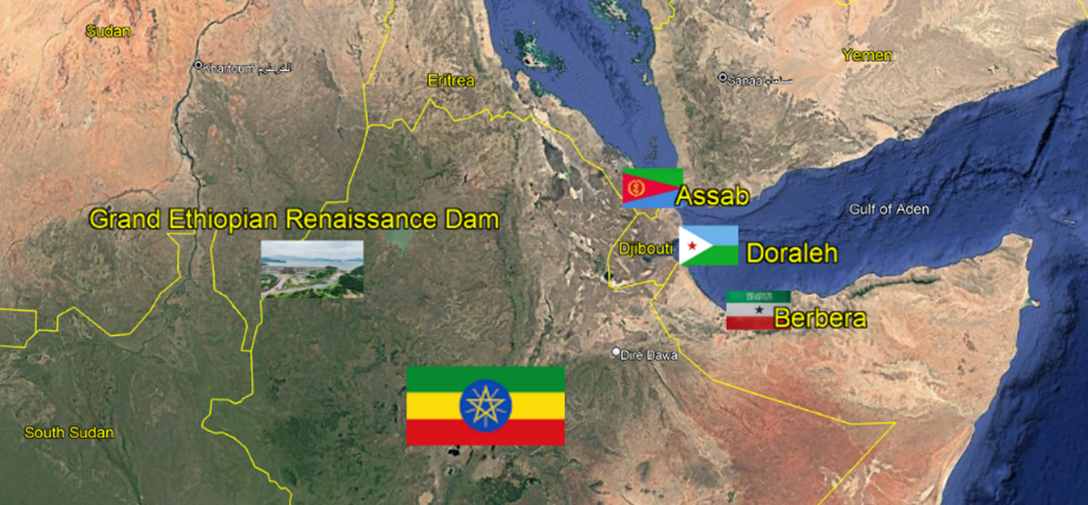
Ethiopia has plenty of water and power but no seaside (Google Earth/Copernicus/CJRC)
Egyptian concerns are understandable, but Ethiopia is unlikely to be swayed by the sponsoring of port developments in Assab and Doraleh, where governments have been adept at keeping geopolitics out of the business of making money from commercial port activities. Most of Ethiopia’s external trade is routed through Djibouti, where the port facilities are run China Merchants, despite the ousting in 2018 of DP World. But as an insurance policy, Ethiopia signed a deal a year ago to lease 12 miles of coastline and port facilities in Berbera, in the unrecognized state of Somaliland.
The Egyptian government might make more progress with Ethiopia by adopting a more conciliatory approach. If a confrontational approach were to escalate, Ethiopia might take advantage of any conflict to recapture access to the sea, which it lost when Eritrea fought for and won its independence in 1993.
Content Original Link:
" target="_blank">