









Report: Lost Russian Ship Was Carrying Nuclear Submarine Reactor Parts
The special cargo aboard the Russian arms ship that went down off Cartagena last year was not what its crew initially reported, according to Spanish outlet La Verdad. The blue-tarped objects on the vessel's stern were likely naval reactor components, unfueled and potentially headed for North Korea, national authorities determined.
In December 2024, Ursa Major was under way in an eastbound convoy through the Strait of Gibraltar, a trip she had made many times before. The vessel was well-known to shipwatchers as a Russian arms ship, and many suggested that she was on another "Syria Express" run to the Russian base at Tartus.
On December 21, Spanish maritime SAR authorities noticed that the vessel was making unusual course changes. On the 22nd, Ursa Major veered to port and slowed to bare steerageway, then drifted. A distress call came at last on the 23rd, and Spanish authorities dispatched search and rescue units. On arrival, they found that the ship was listing, two engineering crewmembers were missing, the engine room was shut tight, and the survivors were ready to abandon ship. 14 surviving crewmembers were evacuated to shore, and the vessel went down soon after.
The circumstances of the vessel's sudden sinking were suspicious, and the maritime captaincy began asking questions. Ursa Major's master, Capt. Igor Vladimirovich Anisimov, initially told investigators that the cargo consisted of more than 100 empty containers, two giant crawler cranes on deck, and two large components for a Russian icebreaker project (the tarped objects located near the stern). All this was headed to Vladivostok, he said.
The two "icebreaker components" were shipped as deck cargo and were visible to spotting planes during the ship's earlier transit (top). Based on aerial surveillance, they were each approximately 20-25 feet square, including any crating material, dunnage and tarping.
Spanish authorities estimated their weight at about 65 tonnes each, suggesting unusual density. La Verdad reports that after the master was pressed on the matter, he asked for time to think, then told investigators that the items were "manhole covers."
Documents seen by La Verdad show that Spanish investigators identified the cargo as a pair of casings for nuclear-submarine reactors - specifically, for a pair of Soviet-era VM-4SG reactors. This model was the final iteration of the VM-series, the naval reactors that powered Russia's nuclear ballistic missile sub fleet through the Cold War. The VM-4SG variant was installed aboard the Delta IV-class submarine, and is still in active service aboard half a dozen of these ballistic missile subs in the Russian Navy.
Public audiences have more access to information about the VM-4SG than they do about most naval reactors. Virtually every parameter and component of a naval reactor is secret: knowledge of its design could help an opponent to target the sub, or to improve their own equipment. Luckily, in 2023 Russia's defense ministry shared rare footage of the inside of a 4M-4SG reactor compartment on a Delta IV, including a detailed video exploration of the control rod system and the visible top of the "lid," which is bolted to the top of the barrel-shaped containment vessel.
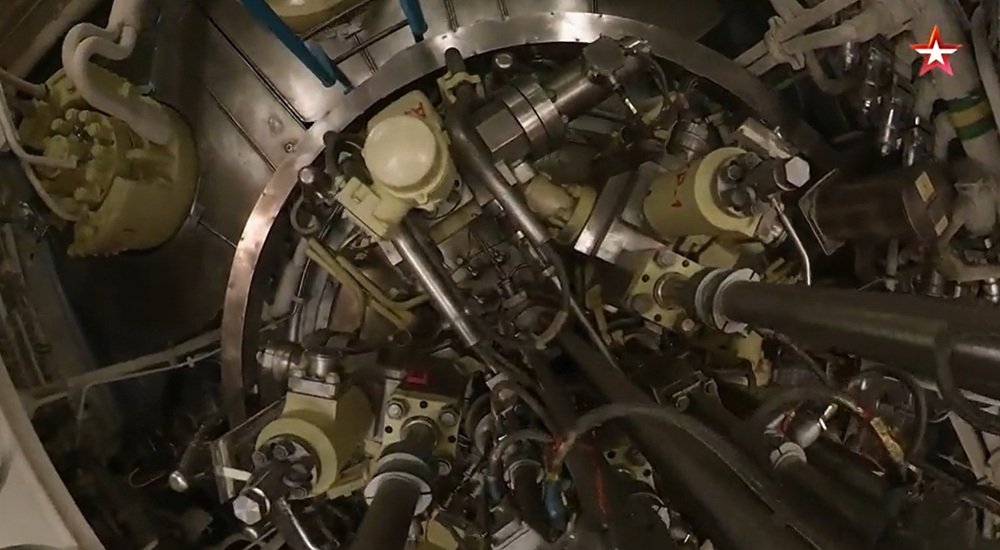
Top of the VM-4SG's lid as viewed from above (TV Zvezda)
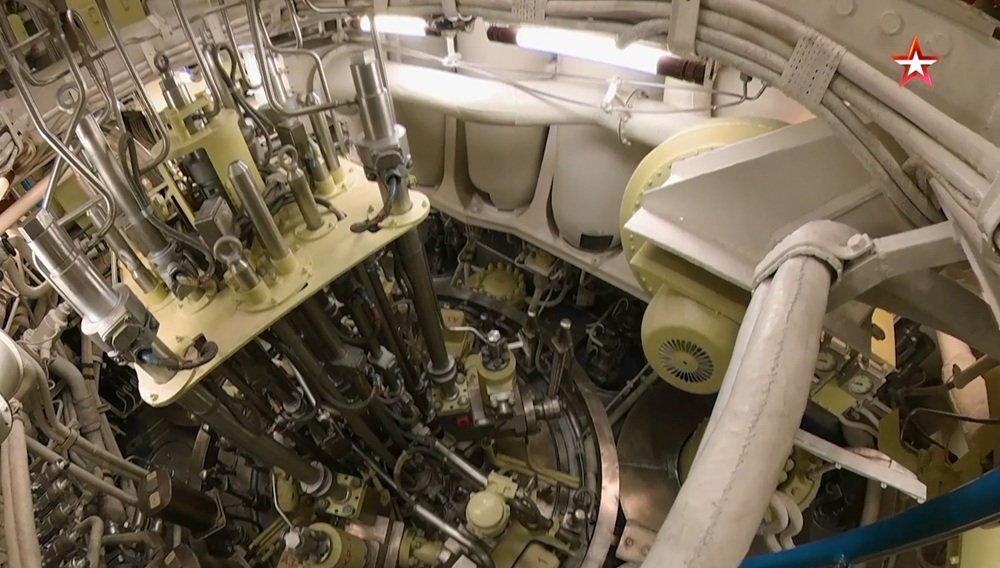
Top of the VM-4SG reactor as viewed from above, including control rods (TV Zvezda)
The lid of this reactor is about three feet thick, and it is made of solid steel to protect the sub's crew from ionizing radiation, propulsion division commander Andrei Leonov told the Russian Ministry of Defense's TV Zvezda channel. This thickness suggests exceptional weight, in line with the suspected mass of the Ursa Major's cargo.
As for the destination, Spanish authorities speculated that the reactor parts may have been destined for the North Korean nuclear submarine program, which just launched its first ballistic-missile sub. Multiple analysts have suggested that the newbuild North Korean vessel likely benefited from Russian technical assistance for its reactor design, and could potentially have incorporated a fully built Russian reactor. Russia owes North Korea a special debt for vast transfers of artillery shells and other munitions, which have helped the Russian Army to reverse losses and begin gaining ground in Eastern Ukraine.
The cause of the Ursa Major's sinking appears to be kinetic. The shipowner told media that there were three explosions and a 20-inch hole in the shell plating, and the captain confirmed that the hole's ragged edges were bent inwards. This is consistent with an explosion on the outside of the hull.
Content Original Link:
" target="_blank">